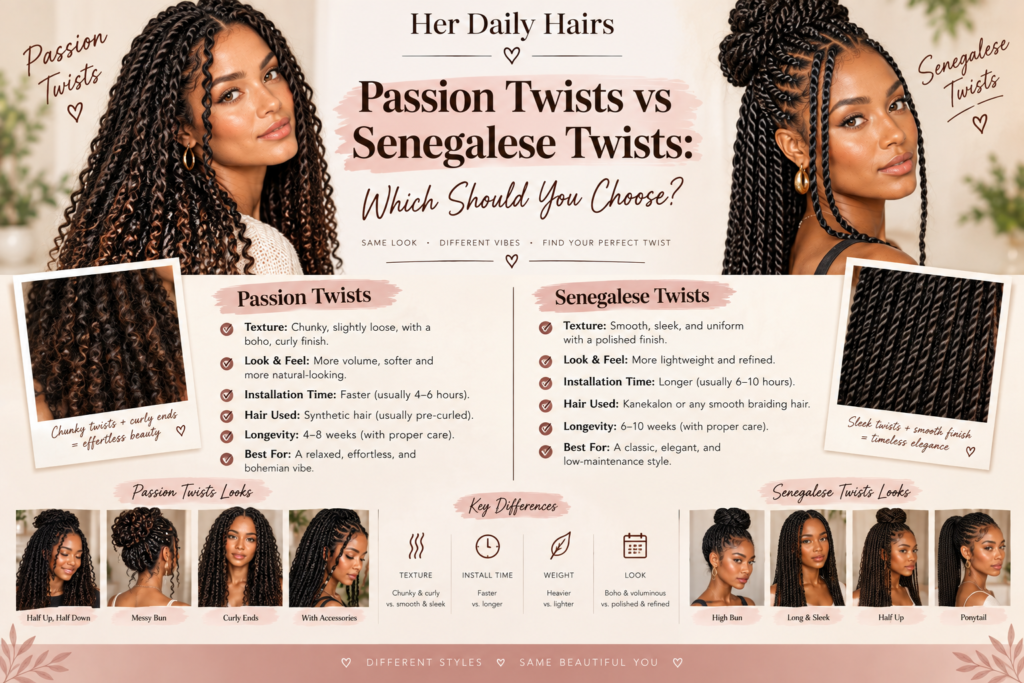
If you’ve narrowed down your next protective style to twists, you’ve probably run into the same question a lot of people do: passion twists vs Senegalese twists — what’s actually different between them, and which one is right for you? Both are popular, long-lasting protective styles built around a two-strand twisting technique, but the finished look, feel, and even the maintenance routine can vary quite a bit depending on which one you choose.
This twist hairstyles comparison breaks down exactly how passion twists and Senegalese twists differ — from the type of hair used to install them, to cost, styling versatility, and how long each one realistically lasts — so you can walk into your next salon appointment (or DIY session) knowing exactly what to ask for.
What Are Senegalese Twists?
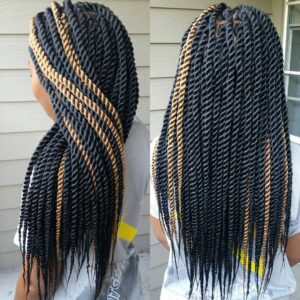
Senegalese twists are a classic, long-standing protective style made by two-strand twisting synthetic Kanekalon extension hair into small to medium sections. The result is a smooth, rope-like twist with a slightly shiny finish, since Kanekalon hair has a sleeker texture than more natural-looking alternatives.
Key characteristics:
- Smooth, sleek finish thanks to the synthetic hair used
- Rope-like, uniform twist pattern
- Lightweight compared to many other extension-based styles
- A more polished, classic look overall
What Are Passion Twists?
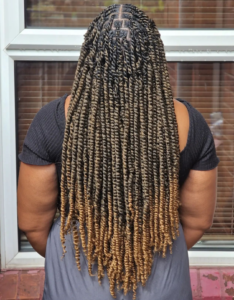
Passion twists are a newer style built using a wavy, textured extension hair (often referred to as “Freetress Water Wave” or similar), rather than the smoother Kanekalon hair used in Senegalese twists. This gives passion twists a softer, more bohemian, curly-textured appearance rather than the sleek finish of traditional twists.
Key characteristics:
- Wavy, textured finish rather than smooth and sleek
- More voluminous appearance due to the curlier extension hair
- A softer, more relaxed overall look
- Popular for a more natural, “your hair but longer” aesthetic
Passion Twists vs. Senegalese Twists: Side-by-Side Comparison
| Passion Twists | Senegalese Twists | |
|---|---|---|
| Extension hair type | Wavy/curly (water wave texture) | Smooth, synthetic (Kanekalon) |
| Overall look | Bohemian, textured, voluminous | Sleek, polished, uniform |
| Weight | Slightly heavier due to wavy hair | Lighter, smoother strands |
| Install time | 4-6 hours (varies by length/density) | 3-5 hours (varies by length/density) |
| Typical cost | Moderate to higher | Moderate |
| Longevity | 4-6 weeks | 6-8 weeks |
| Best for | Softer, curlier aesthetic | Sleek, classic protective look |
| Maintenance | Slightly more upkeep to maintain wave pattern | Lower maintenance overall |
How Passion Twists and Senegalese Twists Compare on Look
The most obvious difference between the two styles is texture. Senegalese twists have a smooth, uniform rope-like appearance from root to end, giving them a clean, classic look that works well for both casual and more polished settings. Passion twists, by contrast, have visible wave and texture throughout, creating a softer, more voluminous silhouette that leans into a bohemian aesthetic.
Neither look is objectively “better” — it really comes down to personal style preference. If you gravitate toward sleek, polished hairstyles, Senegalese twists are likely the better fit. If you prefer a softer, curlier, more relaxed look, passion twists are probably more your style.
How They Compare on Cost and Install Time
Because passion twists use a specific type of textured extension hair (which can be pricier than standard Kanekalon), they tend to cost slightly more than Senegalese twists on average, though pricing varies significantly by salon, location, and stylist experience.
Install time is fairly similar between the two, though passion twists can sometimes take slightly longer due to the extra step of styling the wavy texture as the twists are installed. Both styles typically take several hours to complete, so it’s worth setting aside a full appointment slot (or a comfortable at-home session) regardless of which you choose.
How They Compare on Maintenance and Longevity
Senegalese twists generally last a bit longer — often six to eight weeks — thanks to the smooth, low-friction texture of the synthetic hair used, which tends to hold up well with minimal frizzing over time.
Passion twists, while still a solid long-term protective style, typically last four to six weeks. The wavy texture that gives them their signature look can start to lose definition and frizz a bit sooner than the smoother twist pattern of Senegalese twists, especially without some extra care (like a light mist of water and mousse to refresh the wave pattern periodically).
Which Should You Choose?
- Choose Senegalese twists if: you want a sleek, polished look, plan to keep the style in for a longer stretch (six to eight weeks), or prefer lower day-to-day maintenance.
- Choose passion twists if: you’re drawn to a softer, more textured, bohemian aesthetic and don’t mind a bit of extra upkeep to maintain the wave pattern, or you plan to wear the style for a shorter four-to-six-week stretch.
- Consider your budget: if cost is a deciding factor, Senegalese twists are typically the more budget-friendly option due to the extension hair used.
- Consider your styling routine: if you like to switch up your look with buns, ponytails, or half-up styles, both twist types work well, though the smoother texture of Senegalese twists can be slightly easier to manipulate into sleek updos.
Which Hair Types Suit Each Style Best?
While both styles work across virtually all natural hair textures, since the extensions do most of the visual work, a few considerations can help guide your choice:
- Fine or thinner natural hair may find Senegalese twists more comfortable, since the smoother, lighter extension hair puts less overall weight and tension on individual strands compared to the fuller, wavier hair used in passion twists.
- Thicker or denser natural hair can typically handle either style well, since there’s enough natural hair to securely anchor either type of extension without excessive strain.
- Those with sensitive scalps or a history of tension-related hair loss may want to discuss twist size and installation tightness with their stylist regardless of which style they choose, since improper installation (rather than the specific twist type) is usually the bigger risk factor for hairline damage.
Styling Versatility: Which Holds Up Better?
Both styles offer a good deal of versatility once installed, but they behave slightly differently when styled:
- Senegalese twists are easier to pull into sleek, polished updos, ponytails, or half-up styles, since the smooth extension hair lies flat and holds a neat shape.
- Passion twists tend to look better worn down or in looser, more textured styles like a half-up bun or a loose side part, since pulling the wavy texture too tightly can sometimes flatten the wave pattern that gives the style its signature look.
If you know you’ll want to wear your protective style up frequently for work or workouts, this is worth factoring into your decision alongside look and cost.
Caring for Either Style
Regardless of which twist style you choose, a few care habits help extend the life of your protective style:
- Sleep with a satin or silk bonnet or pillowcase to reduce friction and frizz overnight.
- Moisturize your scalp regularly with a lightweight oil or leave-in spray, even though your natural hair is tucked away underneath.
- Avoid excessive tension when styling twists into updos or ponytails, since repeated pulling at the root can strain your natural hairline over time.
- Refresh with a light mist and light oil as needed to reduce frizz, particularly important for maintaining the wave pattern in passion twists.
Frequently Asked Questions About Passion Twists and Senegalese Twists
Which style is better for natural hair growth? Both styles are equally protective for hair growth and length retention when installed correctly, since the core benefit — tucking away and minimizing manipulation of your natural ends — applies to both.
Can I convert Senegalese twists into passion twists (or vice versa) without starting over? Not directly, since the two styles use different extension hair textures. You would need to remove the existing twists and reinstall with the new hair type to switch between the two looks.
Do passion twists frizz more than Senegalese twists? Generally, yes, due to the wavy texture of the extension hair used in passion twists. This isn’t necessarily a downside for everyone, since some frizz can actually enhance the bohemian look passion twists are known for, but it does mean slightly more maintenance to keep the style looking fresh.
Are passion twists heavier than Senegalese twists? Passion twists tend to be marginally heavier due to the textured extension hair, though the difference is usually minor and shouldn’t cause significant discomfort for most people when installed properly.
How much do passion twists and Senegalese twists typically cost? Pricing varies widely by salon, stylist experience, and location, but passion twists tend to run slightly higher than Senegalese twists on average due to the cost difference in extension hair.
Final Thoughts
Passion twists and Senegalese twists both deliver on the core promise of a great protective style — length retention, low daily manipulation, and weeks of low-maintenance styling — but the finished look and feel couldn’t be more different. If you’re drawn to a sleek, classic silhouette, Senegalese twists are likely your best bet. If a softer, more textured, bohemian look is more your speed, passion twists are worth the slightly higher cost and upkeep.
Loved this comparison? Save it to Pinterest so you have it ready for your next protective style appointment.
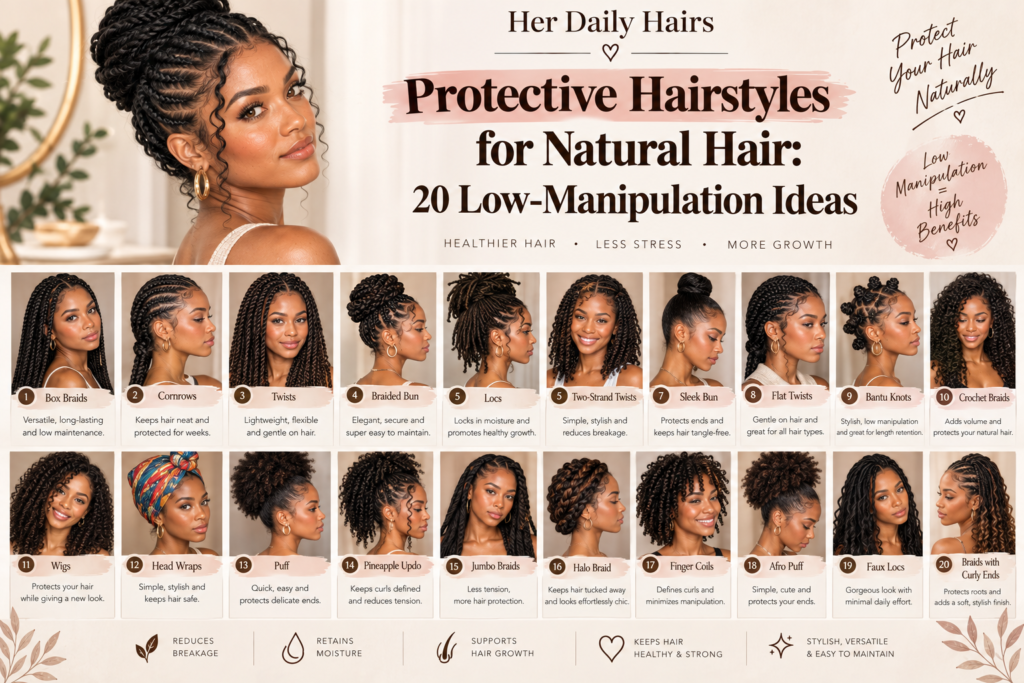
Looking for more braid and twist comparisons? Check out our guides on Dutch Braid vs French Braid and Protective Hairstyles for Natural Hair: 20 Low-Manipulation Ideas for more styling inspiration.